What is a Grecian wedding dress? Cut, fabrics and styling
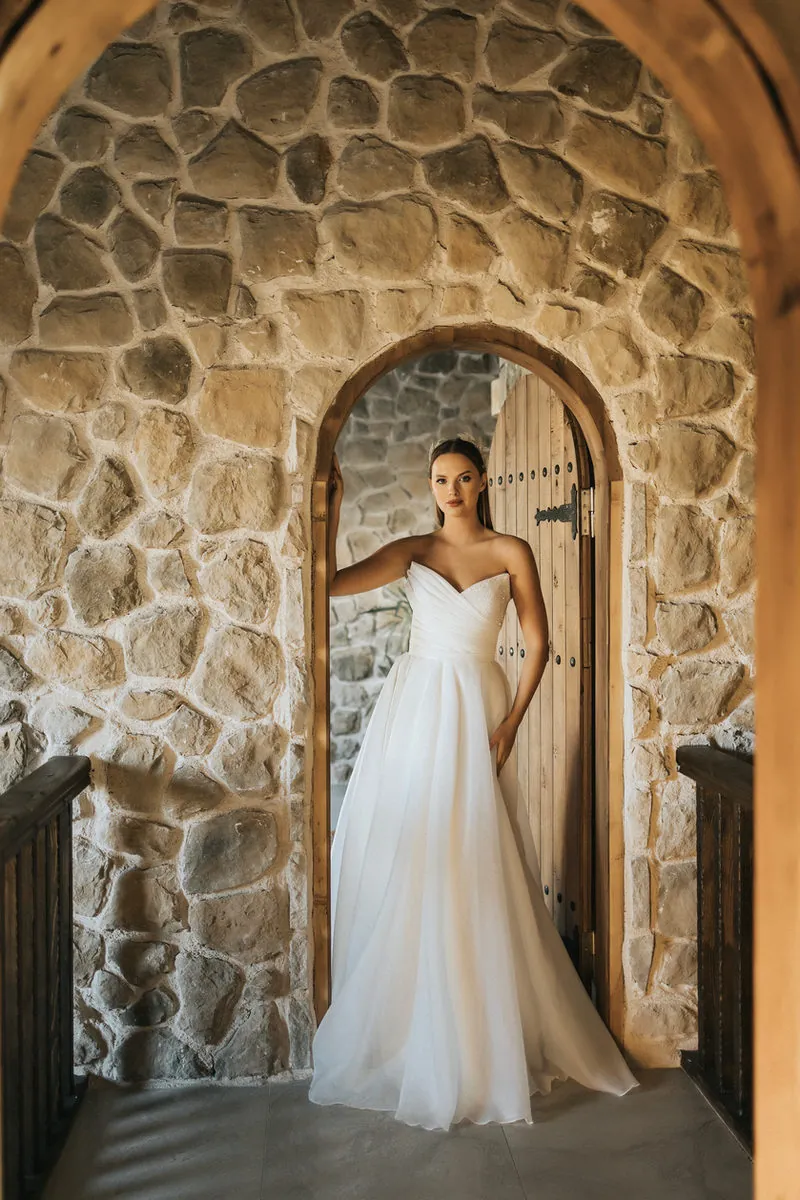
A Grecian wedding dress takes its name from the clothing of ancient Greece. It has an empire waist, a draped bodice and a skirt that flows freely to the floor. It is made in chiffon, crêpe or silky fabrics, and it is light and fluid rather than full.
The word "Grecian" appears often when you browse wedding dresses, but it is rarely explained. A few clear details set this style apart, and once you know them, finding the gown you have in mind becomes much easier.
What defines a Grecian dress?
It is more a style than a single silhouette. Four details make it easy to recognise:
- Empire waist: the waistline sits just below the bust, and the skirt falls straight to the floor from there.
- Drape: the bodice is shaped by folds, gathers or crossed fabric rather than seams.
- Flowing skirt: no full petticoats or stiff tulle. The skirt moves as you walk.
- Neckline: a one-shoulder, a V or a draped crossover neckline is common.
A gown does not need all four. If it has an empire waist and a flowing skirt, it will usually be called Grecian.
Which fabrics work best?
The fabric gives a Grecian dress its character. A heavy, structured fabric cannot create the same movement.
- Chiffon: the classic choice. Light, airy and slightly sheer; layered, it gives the skirt a soft volume.
- Crêpe: more matte and a little heavier. It shows the drape clearly and feels modern and understated.
- Silky satin: reflects light softly and brings out the folds of a draped bodice.
- Fine tulle: can add lightness to the skirt, although full tulle on its own changes the Grecian mood.
Fabric looks very different in photographs. Chiffon almost floats in daylight, while crêpe gives a crisper line under evening lights. Trying both near a window and indoors makes the choice easier.
Grecian, sheath and A-line: the difference
These three are often confused, because none is as full as a ball gown.
- Grecian: empire waist, a skirt that flows lightly to the floor. Romantic and full of movement.
- Sheath: a natural or undefined waist and a straight, close line. Minimal and modern.
- A-line: a natural waist and a skirt that widens like the letter A. Classic and balanced.
In short, a Grecian dress is about drape and movement, a sheath about clean lines, and an A-line about the shape of the skirt.
Which weddings suit it?
Its lightness makes it a natural choice for garden, terrace, countryside and beach weddings, and it is easy to move in through a long day.
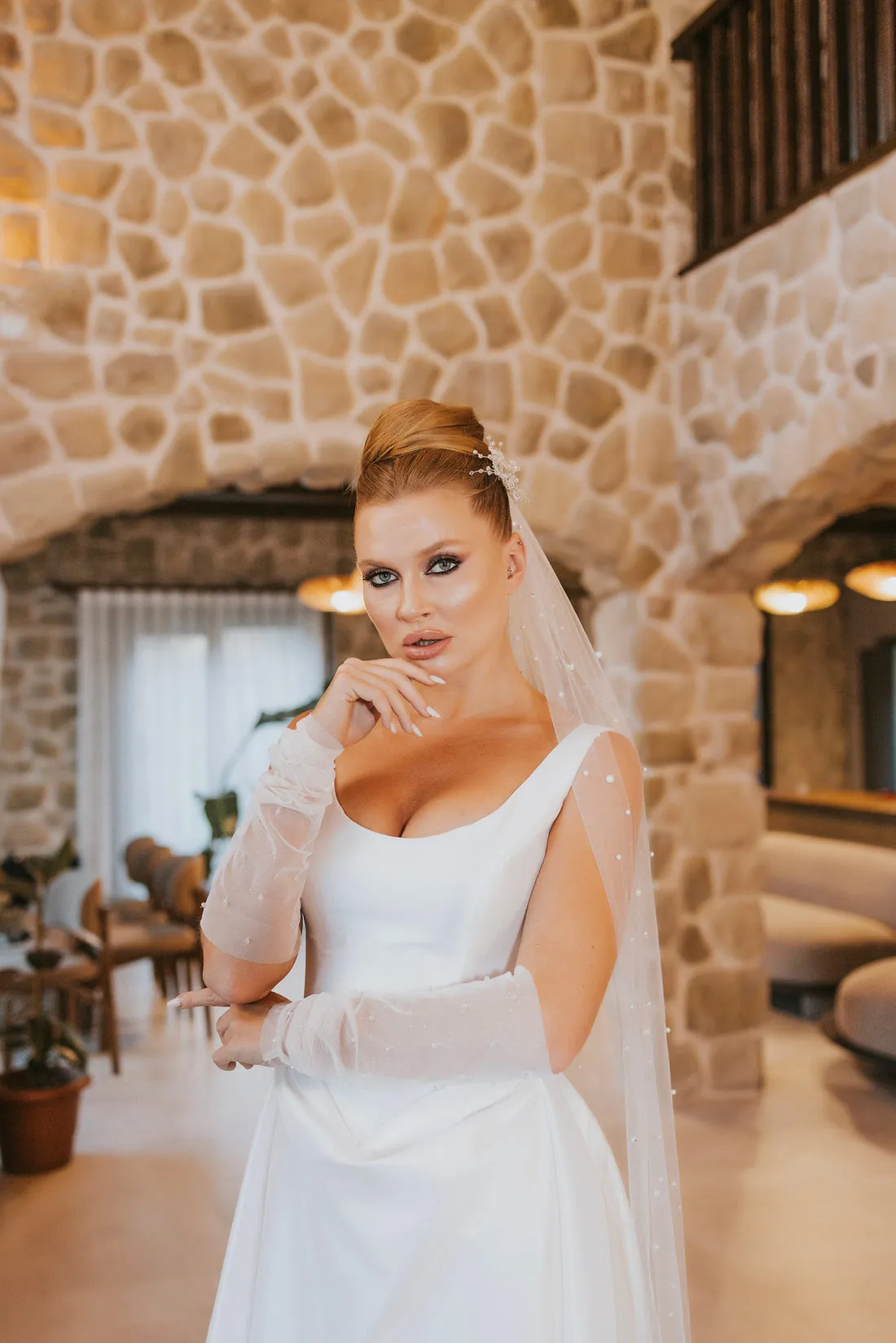
It is just as elegant in a ballroom, often in crêpe or satin, with a longer train or a crystal-embellished waist. For a winter wedding, long sleeves and a heavier lining keep the same flow.
A few styling ideas:
- A draped neckline already draws the eye, so keep the necklace simple, or skip it; earrings may be enough.
- A low bun, a side braid or soft waves complete the look.
- If you would like a veil, a fine tulle veil without an embroidered edge sits naturally with the flowing fabric.
- A slim crystal belt or a satin ribbon defines the empire waist.
Can a Grecian dress be modest?
Yes. The draped bodice and flowing skirt suit modest gowns beautifully. With a high or round neckline and long chiffon sleeves, the same lightness remains, and the skirt flows in harmony with the hijab.
The one thing to plan is the lining. Chiffon is slightly sheer, so a full lining is needed, which adds a little weight. You can read more in our guide to choosing a modest wedding dress.
A Grecian-inspired gown at Henna Bride
In our collection, look for empire waists, draped necklines and flowing fabrics. If the gown you imagine is not there, we can design it with you and make it to your measurements, and every design can be made modest. To see an idea first, try our gown designer and choose a sheath silhouette, crêpe or lace and your neckline.
Fittings at our boutiques in İzmit and Ankara are complimentary, and if you live abroad we can begin with a video consultation. Details are on our worldwide delivery page.
Frequently asked questions
Is a Grecian dress the same as a Greek-style dress?
Yes. Grecian and Greek-style describe the same look: an empire waist, drape and flowing fabric.
Can a Grecian dress be full?
Usually not. Layered chiffon can give the skirt a soft volume, but stiff tulle and a full petticoat take away the Grecian feel.
Can I wear a Grecian dress in winter?
Yes. With long sleeves, a heavier lining and a fabric such as crêpe or satin, it works well for a winter wedding.
Can a Grecian dress have a train?
It can. A short train that brushes the floor is the most common, and a longer train suits a ballroom wedding.